Showing posts with label vascular. Show all posts

Thursday, March 19, 2009

STROKE and Your OWN STEM CELLS

"Every five minutes someone in the UK has a stroke and it is vital that we do all we can to help those affected by stroke."

Wise words from a team of wise scientists in the UK that pushed effective stem cell treatment for strokes a significant step forward as they revealed in their work is published in the Journal Biomaterials how they have replaced stroke-damaged brain tissue in rats.

The team of scientists is funded by the Biotechnology and Biological Sciences Research Council (BBSRC) and led by Dr Mike Modo of the Institute of Psychiatry, King's College London. The work, carried out at the Institute of Psychiatry and University of Nottingham, shows that by inserting tiny scaffolding with stem cells attached, it is possible to fill a hole left by stroke damage with brand new brain tissue within 7 days. Previous experiments where stem cells have been injected into the void left by stroke damage have had some success in improving outcomes in rats.

The problem is that in the damaged area there is no structural support for the stem cells and so they tend to migrate into the surrounding healthy tissues rather than filling up the hole left by the stroke.

Dr Modo said: "We would expect to see a much better improvement in the outcome after a stroke if we can fully replace the lost brain tissue, and that is what we have been able to do with our technique."

Using individual particles of a biodegradable polymer called PLGA that have been loaded with neural stem cells, the team of scientists have filled stroke cavities with stem cells on a ready-made support structure.

Dr Modo continued: "This works really well because the stem cell-loaded PLGA particles can be injected through a very fine needle and then adopt the precise shape of the cavity. In this process the cells fill the cavity and can make connections with other cells, which helps to establish the tissue. (picture)

"Over a few days we can see cells migrating along the scaffold particles and forming a primitive brain tissue that interacts with the host brain. Gradually the particles biodegrade leaving more gaps and conduits for tissue, fibres and blood vessels to move into."

The research published today uses an MRI scanner to pinpoint precisely the right place to inject the scaffold-cell structure. MRI is also used to monitor the development of the new brain tissue over time.

The next stage of the research will be to include a factor called VEGF with the particles. VEGF will encourage blood vessels to enter the new tissue.
Professor Douglas Kell, BBSRC Chief Executive said: "Stroke is a leading cause of disability in industrialised countries. It is reassuring to know that the technology for treating stroke by repairing brain damage is getting ever closer to translation into the clinic.

This crucial groundwork by Dr Modo and his colleagues will surely be a solid foundation of basic research for much better treatments in the future. Joe Korner, Director of Communications at The Stroke Association commented: "This research is another step towards using stem cell therapy in treating and reversing the brain damage caused by stroke. It is exciting because researchers have shown they are able to overcome some of the many challenges in translating the potential of using stem cells into reality."

The potential to reverse the disabling effects of stroke seems to have been proved. However the development of stem cell therapy for stroke survivors is still in the early stages and much more research will be needed before it can be tested in humans or used in practice.

Friday, June 22, 2007

Bristol Cardiac Team Uses Stem Cells for Heart

Articles from or about Bristol always brings with them a sense of nostalgia for me and its been a while since the last opportunity to visit (StemLife keeps me in Asia, mostly).

Anyway, back to the stem cell news. I was very pleased to see that the Bristol cardiac team based at the Bristol Royal Infirmary and at the University will in August start a stem cell program which involves the injection of autologous (patient's own) bone marrow stem cells into the affected heart during routine coronary bypass surgery. The surgeons, led by Dr. Raimondo Ascione, believe that stem cells can assist in the healing process post surgery, reducing scarring and thereby improving the heart's pumping action. Follow-up time of the patients is stated to be six months, which I think is a perfectly reasonable length of time (based on our experience here).

The work is funded by the British Heart Foundation and amounts to GBP 210,000 (approximately 1,455,070 RM).


The article describes why the surgical team acknowledges the usefulness of stem cells:

In a heart attack, blocked blood vessels starve the heart's muscle of oxygen and cells in that part of the heart die, leaving scarring.

The scarred heart is then less able to pump blood around the body and can lead to heart failure.

While the blood supply to the heart can be improved with coronary bypass surgery or angioplasty (mechanical stretching of the heart blood vessels), these techniques do not restore the viability and function of the area already damaged.

And scarring can cause further complications - a fifth of patients develop a dangerous thinning of the walls of the heart within six months of bypass surgery.


The patients who will be selected are those who suffered a heart attack between 10 days to three months ago, and half of them will receive the stem cells, while the other half will receive a dummy injection.


Are there any ethical issues?

Dr. Ascione says that using the patient's own stem cells will not only avoid the risk of rejection and infection, but also get round any ethical issues sometimes associated with embryonic cells or foetal tissue (which is hotly debated). It was also great that Professor Jeremy Pearson, Associate Medical Director of the British Heart Foundation, is also looking forward to stem cells being used routinely in the repair of damaged hearts.


At StemLife, we also offer adult-derived stem cell therapies for patients with ischemic heart disease. Not all patients are eligible for the program however, so please check with us to see if you're a suitable candidate.

Thursday, March 22, 2007

Stem Cells for John Plummer's Heart

More and more companies are moving into the US stem cell therapeutic arena, this is probably a good indicator that StemLife is moving in the right direction.

Here's an article that makes a few interesting points, with doctors making positive and strong statements that will lead the industry forward. The exciting thing about the stem cell industry is that it crosses the boundaries between healthcare and science and really seems to have convinced many physicians that this is really the way to go. Stem cell medicine makes gene therapy and other more technical innovations seem not only expensive, but very far away from reality and practicality.

Doctors at Vanderbilt University have led the way in the US to be the first few medical centers to perform stem cell therapy for stimulating regeneration of the heart muscle after heart attacks. Funded by a company called Amorcyte, the trial runs on for five years where the patients enrolled will be monitored on a yearly basis.

I thought the following points were worth noting:

a) Both Chief of Cardiovascular Medicine, Dr. Douglas Vaughan and Director of the Cardiac Cath Lab Dr. David Zhao were very positive about stem cell medicine.

Dr. Douglas Vaughan, had very positive comments to make about stem cell therapy saying that it had the potential to "transform the way we treat people with cardiac disease".

Dr. David Zhao was quoted as saying,"If we treat a patient rapidly, some may not have any damage at all, but for those who, despite all efforts, suffer damage to the heart muscle, we are studying the effects of this treatment in repairing the heart muscle."

b) the article notes that most stem cell work has been conducted in Europe and only recently commenced in the US

c) the patient, a 63 yr old Professor, is delightfully enthusiastic that he's undergoing the treatment

d) the stem cells harvested are delivered in exactly the same way as StemLife's current method

e) preliminary results seen within 3-6 months

f) lastly but certainly not leastly, full support and funding from government body NIH.


Quote from the patient:

"There are no guarantees," said Plummer. "It was the prospect of improvement - any improvement - that made it worth it. There are certain risks, but the prospect of the study proving to be valuable to others as well, all of those considerations made it seem like something I ought to do."

"I look at it this way. This is an improvement you would give almost anything to make. There is nothing more important than your general health."

Monday, March 05, 2007

Pop! Goes My Heart... Stem Cells for Carrol Payne & Hugh Grant

I have two happy videos to share about hearts today.

The first one is about a firefighter, Carrol Payne, whose heart wasn't quite functioning as well anymore. He describes having a heart attack, being admitted to hospital and enrolling in a study to use stem cells as the treatment.

There were a few notable points in the article. Firstly, the doctor recommends extraction of the bone marrow stem cells between day 6-9 of the heart attack. This probably allows the infarcted area to settle down a little and ensure that the patient hasn't got further complications as a result of the heart attack. Secondly, that the bone marrow is extracted under local anaesthesia but there is no mention of how much in terms of volume. Thirdly, that the stem cells were sent to the lab, separated and re-infused using a catheter. The treating doctor, Dr. Quyyumi believes that the stem cells may help to regenerate the muscles of the heart and heal the blood vessels to recover the edges of the heart.


I am really pleased that the patient is feeling much better, we also see very similar results with StemLife's patients who are symptomatic and undergo peripheral stem cell harvesting and therapy (but with no surgery).

I'm looking to more of the work from Dr. Quyyyumi, although I know it isn't easy to organize as there is a fair amount of coordination required between patient, doctor, lab and every single member of hospital staff in between.


The second video is a one which I really enjoyed (showing my age here) but to truly appreciate it, you'll have to go watch this movie in the theatres called "Music and Lyrics" which stars Hugh Grant and Drew Barrymore. I won't reveal the story here but felt that the music video was re-creating a heart attack* and has a certain amount of relevance to our topic on stem cells.


Watch this youtube version (its hilarious) and maybe try singing along to the lyrics that I adjusted for this blog entry... but I'm no lyricist so tell me if you can come up with a better stem cell version :)


[VERSE 1]
I never thought that I could be in so much pain,
Everytime that I do a bit of exercise.
A squeeze inside me that words just can't describe,
And there's no explaining.
There's something that's disturbing my sleep, I can't deny,
Every pill to my lips is a lullaby.
Angioplasty makes life worth while,
I feel cold and shiver.

[CHORUS]
I said I wasn't gonna eat the bread, but then
POP! Goes my heart.
I wasn't gonna take my pills again, but then
POP! Goes my heart.
And I just can't live with thick blood flow,
I just don't have the feeling.

[VERSE 2]
These precious moments, I have so few,
Let me go to see StemLife, where they can get your stem cells today.
You show to me that my vessels are new,
And there's no explaining.


*Author's note: Hugh Grant's heart attack in the music video can be classified as a heart break which mimics a heart attack. Ever felt one before? Read more about heart break attacks here.

Thursday, November 16, 2006

Growing New Arteries - Brains, Legs and maybe even Erections


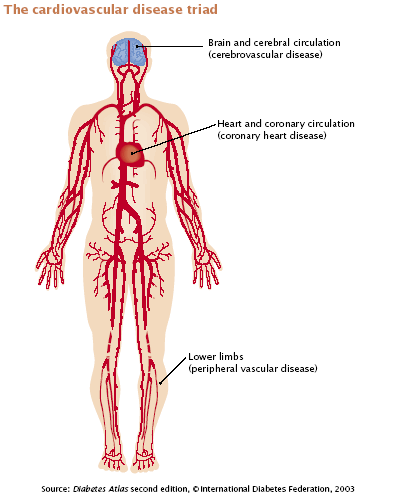
Its been known for a while now that cytokine stimulated stem cells typically used in bone marrow transplantation can be harnessed for vascular regeneration. This particular capacity has been demonstrated in the heart and also in diabetic patients with peripheral vascular disease (PVD). However, due to poor circulation in the area of interest, stem cells need to be "transplanted" from the source of stem cells to the site of the problem.

This latest article mentions the use of GCSF in the regeneration of blood vessels in patients with vascular disease. Citing the administration of this cytokine as a "new treatment", a farmer by the name of Tom Reynolds who was 77 years of age had poor circulation and leg pain. Concerned and afraid about possible gangene infection and limb amputation, Mr. Reynolds tried GCSF injections.

Administered by Dr. Arshed Quyyumi, a cardiologist, Mr. Reynolds has since experienced improved circulation and less pain.


Extracted from emedicine.com:

"Vascular disease may manifest acutely when thrombi, emboli, or acute trauma compromises perfusion. Thromboses are often of an atheromatous nature and occur in the lower extremities more frequently than in the upper extremities. Multiple factors predispose patients for thrombosis. These factors include sepsis, hypotension, low cardiac output, aneurysms, aortic dissection, bypass grafts, and underlying atherosclerotic narrowing of the arterial lumen.

Emboli, the most common cause of sudden ischemia, usually are of cardiac origin (80%); they also can originate from proximal atheroma, tumor, or foreign objects. Emboli tend to lodge at artery bifurcations or in areas where vessels abruptly narrow. The femoral artery bifurcation is the most common site (43%), followed by the iliac arteries (18%), the aorta (15%), and the popliteal arteries (15%)."


I learned from a renown urologist in Malaysia that erectile dysfunction is one of the most common indicators of heart disease and vessel occlusion (small vessel involvement). Diabetics often are unable to enjoy intimacies because of this physical obstruction in blood vessels. I wonder if the doctors will follow up on other aspects of Mr. Reynold's quality of life...? :) That would be an interesting anecdote indeed.