
In a groundbreaking study (click on title for abstract), just published and not yet picked up by the media, researchers from the Departments of Anatomy and Physiology and Diagnostic Medicine/Pathobiology at the College of Veterinary Medicine in Kansas State University in Kansas, reported in the February edition of the journal "Cancer Research" that "Rat Umbilical Cord Stem Cells Completely Abolish Rat Mammary Carcinomas with No Evidence of Metastasis or Recurrence 100 Days Post-Tumor Cell Inoculation."
What they did was that they transplanted Fisher 344 rat-derived mammary adenocarcinoma cells (Mat B III-breast cancer) orthotopically (meaning into the breast of the female rats) into syngeneic (related) F344 rats with an intact immune system. Then they injected rat umbilical cord matrix stem (rUCMS) cells derived from Wharton's jelly, intratumoral (i.t. meaning into the tumor) or i.v. (into the veins of the animals) 4 days later.
Then they compared the tumor attenuation effect (meaning how the tumor was suppressed-fought / extinguished) at day 14 after the injection in the tumor or in the veins in cord blood stem cell-transplanted rats compared with sham-transplanted rats (meaning animals that received an injection but no stem cells). What they saw was amazing!
Unmodified rUCMS cord blood stem cell-transplanted rats showed complete regression of tumors to undetectable levels by 34 to 38 days with no evidence of metastasis or recurrence 100 days post-tumor cell inoculation (injection in the tumor). They concluded that their findings suggest that "unmodified human UCMS cells (cord blood stem cells from the Wharton's jelly of the umbilical cord) could be used for targeted cytotherapy for breast cancer".
Well, this is REALLY something to look out for, isn't it?! [Cancer Res 2009; 69(5): 1815-20]
Showing posts with label blood vessels. Show all posts
Showing posts with label blood vessels. Show all posts
Tuesday, March 03, 2009


Thursday, February 21, 2008
Bioengineering like the movies: Stem Cell Capturing Gadget

I'd hate to sound as if I was brought up on an entertainment diet of Hollywood movies, but back in the 1970's to 80's there was a real revolution in cinematic production and audience interest that led to a cult following of the science fiction genre.
Film directors often take what's probable in science and stretch them to the limits of our imagination, engaging us to just reflect on not only how far we've come but also how much further we can aspire. This next entry is a tribute to the 1987 movie "Inner Space"*.
In a recent announcement, MIT's bioengineers have designed an implantable device that is capable of capturing pure samples of stem cells from the circulating blood. The device is described as "a length of plastic tubing coated with proteins" which has been experimentally implanted into the bloodstream of rats.
The more accurate medical description of this plastic tubing is known as a "shunt" and the method of implantation would most likely involve the severance and reconnection of a small but high through-flow blood vessel. The proteins -known as selectins- attract and trap specific cells with the right signals on the surface (imagine a sticky mat). The cell capture devices are developed by chemical engineers led by Associate Professor Michael King from the Biomedical Engineering department at the University of Rochester. The technical details will be described in the March edition of the British Journal of Hematology.
(personal note: Mr. B.C. this is for you.)
WHY IS THIS DEVICE IMPORTANT?
The medical impact of this device could weigh in for cancer patients who may need to use autologous (one's own) stem cells for their treatment. These cancer patients are treated with chemotherapy to reduce and eliminate as many of the malignant circulating cancer cells as possible from the bloodstream and bone marrow. The treating doctor will collect the patient's own stem cells during this period of remission when the cancer load is at its lowest.
The patient's own stem cells are stimulated using GCSF (read about it here) and the stem cells are harvested and stored in anticipation of the possibility that the cancer cells will multiply again, requiring another round of chemotherapy which may damage the existing healthy marrow further. The collected stem cells will be infused back to the patient to ensure that the patient has sufficient stem cells to repopulate and replenish the marrow, thereby restoring normal cell levels to the bloodstream.
To address the concern that perhaps cancer cells from the patient might also be collected in the same fraction as the healthy stem cells (impossible to distinguish during harvesting) this device could lend a hand to filter out the cancer cells inside or out of the patient's body, i.e. the cancer cells would travel around the bloodstream until they reach the shunt, where they would then be immobilized.
Note though, that the inventors have conceded that this device will not be able to collect enough stem cells for a transplant, therefore the customary stem cell collection procedures will still need to be performed.
SOME INTERESTING STATISTICS
According the A/Prof. King, the shunt placed in an non-GCSF induced rat in a 2 hour period enabled the capture of 3-4 times the number of usual stem cells obtained in normal circulating bloodstream (approx 1%). Hence the device is thought to attract and specifically retain a significantly higher number of stem cells.
This stem cell number could be significantly higher in patients who have been mobilized.
WHAT ELSE CAN IT DO?
Well, it is a concept device which will be as good as its selectin coating. A/Prof. King has already forecasted the use of the device in trapping specific cancer cells in the body to prevent metastatic spread and layering in proteins which could help steer cell development processes by differentiating them while passing through the shunt. (analogy: think sticky mats for dust, sticky mats for cockroaches, sticky mats for cat fur...all requiring different levels of stickiness for its target)

WHEN CAN I BUY IT?
The entrepreneurial A/Prof. King has already started a company by the name of CellTraffix and the anti-metastasis implants are set for animal trials later this year in collaboration with bioengineers Professor Jeffrey Karp and Robert Langer at Harvard and MIT who will develop stable selectin coatings that will last over months than days. Meanwhile, the CEO of CellTraffix, Tom Fitzgerald has already announced that the company's first product for researchers to capture stem cells or cancer cells for lab experimentation will be marketed by early 2009, with clinical testing of the anti-cancer coatings in 2010.
Read how a chance encounter between a bioengineer and a haematology clinician gave rise to this work and watch the cells being captured here (note that you will need a high speed broadband connection as the video files are rather large).
*Why does this remind me of the movie Inner Space I hear you ask... well the term cell capturing device often conjurs up the image of a little machine (like the exploration submersible the protaganist uses) to grab and hold onto cells in circulation :)
Monday, March 05, 2007
Pop! Goes My Heart... Stem Cells for Carrol Payne & Hugh Grant
I have two happy videos to share about hearts today.
The first one is about a firefighter, Carrol Payne, whose heart wasn't quite functioning as well anymore. He describes having a heart attack, being admitted to hospital and enrolling in a study to use stem cells as the treatment.
There were a few notable points in the article. Firstly, the doctor recommends extraction of the bone marrow stem cells between day 6-9 of the heart attack. This probably allows the infarcted area to settle down a little and ensure that the patient hasn't got further complications as a result of the heart attack. Secondly, that the bone marrow is extracted under local anaesthesia but there is no mention of how much in terms of volume. Thirdly, that the stem cells were sent to the lab, separated and re-infused using a catheter. The treating doctor, Dr. Quyyumi believes that the stem cells may help to regenerate the muscles of the heart and heal the blood vessels to recover the edges of the heart.
I am really pleased that the patient is feeling much better, we also see very similar results with StemLife's patients who are symptomatic and undergo peripheral stem cell harvesting and therapy (but with no surgery).
I'm looking to more of the work from Dr. Quyyyumi, although I know it isn't easy to organize as there is a fair amount of coordination required between patient, doctor, lab and every single member of hospital staff in between.
The second video is a one which I really enjoyed (showing my age here) but to truly appreciate it, you'll have to go watch this movie in the theatres called "Music and Lyrics" which stars Hugh Grant and Drew Barrymore. I won't reveal the story here but felt that the music video was re-creating a heart attack* and has a certain amount of relevance to our topic on stem cells.
Watch this youtube version (its hilarious) and maybe try singing along to the lyrics that I adjusted for this blog entry... but I'm no lyricist so tell me if you can come up with a better stem cell version :)
[VERSE 1]
I never thought that I could be in so much pain,
Everytime that I do a bit of exercise.
A squeeze inside me that words just can't describe,
And there's no explaining.
There's something that's disturbing my sleep, I can't deny,
Every pill to my lips is a lullaby.
Angioplasty makes life worth while,
I feel cold and shiver.
[CHORUS]
I said I wasn't gonna eat the bread, but then
POP! Goes my heart.
I wasn't gonna take my pills again, but then
POP! Goes my heart.
And I just can't live with thick blood flow,
I just don't have the feeling.
[VERSE 2]
These precious moments, I have so few,
Let me go to see StemLife, where they can get your stem cells today.
You show to me that my vessels are new,
And there's no explaining.
*Author's note: Hugh Grant's heart attack in the music video can be classified as a heart break which mimics a heart attack. Ever felt one before? Read more about heart break attacks here.
The first one is about a firefighter, Carrol Payne, whose heart wasn't quite functioning as well anymore. He describes having a heart attack, being admitted to hospital and enrolling in a study to use stem cells as the treatment.
There were a few notable points in the article. Firstly, the doctor recommends extraction of the bone marrow stem cells between day 6-9 of the heart attack. This probably allows the infarcted area to settle down a little and ensure that the patient hasn't got further complications as a result of the heart attack. Secondly, that the bone marrow is extracted under local anaesthesia but there is no mention of how much in terms of volume. Thirdly, that the stem cells were sent to the lab, separated and re-infused using a catheter. The treating doctor, Dr. Quyyumi believes that the stem cells may help to regenerate the muscles of the heart and heal the blood vessels to recover the edges of the heart.
I am really pleased that the patient is feeling much better, we also see very similar results with StemLife's patients who are symptomatic and undergo peripheral stem cell harvesting and therapy (but with no surgery).
I'm looking to more of the work from Dr. Quyyyumi, although I know it isn't easy to organize as there is a fair amount of coordination required between patient, doctor, lab and every single member of hospital staff in between.
The second video is a one which I really enjoyed (showing my age here) but to truly appreciate it, you'll have to go watch this movie in the theatres called "Music and Lyrics" which stars Hugh Grant and Drew Barrymore. I won't reveal the story here but felt that the music video was re-creating a heart attack* and has a certain amount of relevance to our topic on stem cells.
Watch this youtube version (its hilarious) and maybe try singing along to the lyrics that I adjusted for this blog entry... but I'm no lyricist so tell me if you can come up with a better stem cell version :)
[VERSE 1]
I never thought that I could be in so much pain,
Everytime that I do a bit of exercise.
A squeeze inside me that words just can't describe,
And there's no explaining.
There's something that's disturbing my sleep, I can't deny,
Every pill to my lips is a lullaby.
Angioplasty makes life worth while,
I feel cold and shiver.
[CHORUS]
I said I wasn't gonna eat the bread, but then
POP! Goes my heart.
I wasn't gonna take my pills again, but then
POP! Goes my heart.
And I just can't live with thick blood flow,
I just don't have the feeling.
[VERSE 2]
These precious moments, I have so few,
Let me go to see StemLife, where they can get your stem cells today.
You show to me that my vessels are new,
And there's no explaining.
*Author's note: Hugh Grant's heart attack in the music video can be classified as a heart break which mimics a heart attack. Ever felt one before? Read more about heart break attacks here.
Thursday, November 16, 2006
Growing New Arteries - Brains, Legs and maybe even Erections
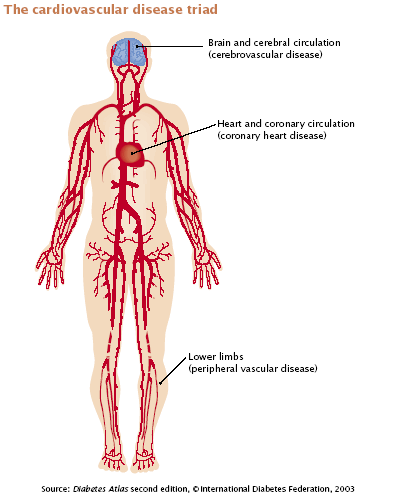
Its been known for a while now that cytokine stimulated stem cells typically used in bone marrow transplantation can be harnessed for vascular regeneration. This particular capacity has been demonstrated in the heart and also in diabetic patients with peripheral vascular disease (PVD). However, due to poor circulation in the area of interest, stem cells need to be "transplanted" from the source of stem cells to the site of the problem.
This latest article mentions the use of GCSF in the regeneration of blood vessels in patients with vascular disease. Citing the administration of this cytokine as a "new treatment", a farmer by the name of Tom Reynolds who was 77 years of age had poor circulation and leg pain. Concerned and afraid about possible gangene infection and limb amputation, Mr. Reynolds tried GCSF injections.
Administered by Dr. Arshed Quyyumi, a cardiologist, Mr. Reynolds has since experienced improved circulation and less pain.
Extracted from emedicine.com:
"Vascular disease may manifest acutely when thrombi, emboli, or acute trauma compromises perfusion. Thromboses are often of an atheromatous nature and occur in the lower extremities more frequently than in the upper extremities. Multiple factors predispose patients for thrombosis. These factors include sepsis, hypotension, low cardiac output, aneurysms, aortic dissection, bypass grafts, and underlying atherosclerotic narrowing of the arterial lumen.
Emboli, the most common cause of sudden ischemia, usually are of cardiac origin (80%); they also can originate from proximal atheroma, tumor, or foreign objects. Emboli tend to lodge at artery bifurcations or in areas where vessels abruptly narrow. The femoral artery bifurcation is the most common site (43%), followed by the iliac arteries (18%), the aorta (15%), and the popliteal arteries (15%)."
I learned from a renown urologist in Malaysia that erectile dysfunction is one of the most common indicators of heart disease and vessel occlusion (small vessel involvement). Diabetics often are unable to enjoy intimacies because of this physical obstruction in blood vessels. I wonder if the doctors will follow up on other aspects of Mr. Reynold's quality of life...? :) That would be an interesting anecdote indeed.
Thursday, October 26, 2006
Stem Cells for the treatment of Ischemic Heart Disease
Finally it looks like the hospitals in the US will soon have results that will get the FDA to approve stem cell therapy as a potential first liner for ischemic heart disease. This report states that approximately 15-20 sites in the US through their respective divisions of cardiology and pathology are investigating 200 randomly selected patients from across the country, harvesting their CD34+ cells and injecting the cells into the heart to investigate the extent of which new blood vessels are formed.
The patients are selected from an existing pool where usual and conventional treatments have already been applied but failed or where no surgical procedures are thought to be helpful. Myocardial ischemia is one of the most severe forms of coronary artery disease, which is the leading killer in the U.S., according to University Hospital officials.
"This is a study to try and reduce chest pain in people that have this coronary disease and have no other options," said Mark Anderson, director of the Division of Cardiology and associate director of the Cardiovascular Research Center, who is involved in the research.
"By increasing the number of those cells present, it encourages the heart to create biological bypasses to connect with another source of blood," he said. "The area of the heart causing pain is not dead. It is alive, but starved."
The disease causes arteries to tighten so that not enough blood passes to areas of the heart, which leads to chest pain and potentially to heart attacks. The stem cells, researchers hope, will spark new paths for blood to get through.
The treatment method is called Autologous Cellular Therapy CD 34-Chronic Myocardial Ischemia Trial or ACT34-CMI, and is funded by Baxter Healthcare Corporation. Appropriately so as Baxter has its own line of products for stem cell harvesting and processing. Increasing the applications for this line of service beyond cancer would add a new revenue stream for the company.
The American Heart Association estimates that 125,000 to 250,000 people with coronary artery disease develop myocardial ischemia each year. In Malaysia, the estimates would range about 12,000 to 25,000 annually. I hope that they would come to us early so that we can help them salvage as many of those starving cells as we can.
On another note, I found this site which tells us what to do if someone is having a heart attack. Could come in handy.
The patients are selected from an existing pool where usual and conventional treatments have already been applied but failed or where no surgical procedures are thought to be helpful. Myocardial ischemia is one of the most severe forms of coronary artery disease, which is the leading killer in the U.S., according to University Hospital officials.
"This is a study to try and reduce chest pain in people that have this coronary disease and have no other options," said Mark Anderson, director of the Division of Cardiology and associate director of the Cardiovascular Research Center, who is involved in the research.
"By increasing the number of those cells present, it encourages the heart to create biological bypasses to connect with another source of blood," he said. "The area of the heart causing pain is not dead. It is alive, but starved."
The disease causes arteries to tighten so that not enough blood passes to areas of the heart, which leads to chest pain and potentially to heart attacks. The stem cells, researchers hope, will spark new paths for blood to get through.
The treatment method is called Autologous Cellular Therapy CD 34-Chronic Myocardial Ischemia Trial or ACT34-CMI, and is funded by Baxter Healthcare Corporation. Appropriately so as Baxter has its own line of products for stem cell harvesting and processing. Increasing the applications for this line of service beyond cancer would add a new revenue stream for the company.
The American Heart Association estimates that 125,000 to 250,000 people with coronary artery disease develop myocardial ischemia each year. In Malaysia, the estimates would range about 12,000 to 25,000 annually. I hope that they would come to us early so that we can help them salvage as many of those starving cells as we can.
On another note, I found this site which tells us what to do if someone is having a heart attack. Could come in handy.
Thursday, August 03, 2006
Cord Blood Stem Cells generates Insulin producing cells
This piece of good news should cheer up diabetics who have been asking us whether cord blood stem cells can help in this lifelong disease. An Irish scientist, Professor Colin McGuckin announced a major breakthrough in demonstrating that cord blood stem cells are able to transform into cells that secrete insulin. This new finding should result in effective in providing insulin to patients from adult sources of stem cells. Prof McGuckin who is a Professor of Regenerative Medicine at the University of Newcastle will be presenting his work to the Catholic church leaders at the Augustinian Institute in Rome.
What is diabetes?
Essentially, diabetes is a condition where the body is unable to produce any (type 1) or enough insulin, or is unable to use the insulin properly (type 2). Insulin is a hormone manufactured and secreted by cells in the pancreas which acts as a signal for the body's cells to absorb blood sugar. If insulin is not produced in enough quantities, cells in the body may not be able to allow blood sugars in which starves the cells of energy.
Which parts of the body are most affected by diabetes?
All cells in the body will be affected by the lack of blood sugar entering the cell. Over time, high blood glucose levels injure blood vessels, resulting in damage to organs which are the most vascularized- eyes, heart, nerves, kidneys. Diabetics are also prone to developing foot ulcers due to poor circulation which increases their risk of limb amputation.
Why is stem cell work on insulin production important?
Diabetes is a chronic disease with symptoms resulting from a failing pancreas. The process is one of pancreatic organ failure and is degenerative in nature. Essentially, diabetics need to control their blood sugars strictly and ensure that they have sufficient levels of insulin (injectable) prior to every meal. Stem cells forming insulin secreting cells may be able to replace the damaged or dying insulin producing cells in the pancreas, thereby yielding long term cost savings in terms of drug therapy and convenience for the patient. Advantages also include non-rejection of tissue (unlike in a pancreas transplant) and the ability of the body to regain natural control over this very important process of hormonal regulation.
Furthermore, predictions and health monitoring from all over the world indicate that diabetes and its effects, is one of the top 3 killers or health burden of people in both developed and developing countries in the world today.
On another note, I'm also pleased that this Catholic Institution is taking the time to invite a notable speaker and hope that other religious organizations would do likewise. StemLife will be happy to provide information on stem cells and stem cell therapy to any religious insitution for the purpose of educating and more importantly, helping people whose condition and suffering may be alleviated by stem cell therapy.
What is diabetes?
Essentially, diabetes is a condition where the body is unable to produce any (type 1) or enough insulin, or is unable to use the insulin properly (type 2). Insulin is a hormone manufactured and secreted by cells in the pancreas which acts as a signal for the body's cells to absorb blood sugar. If insulin is not produced in enough quantities, cells in the body may not be able to allow blood sugars in which starves the cells of energy.
Which parts of the body are most affected by diabetes?
All cells in the body will be affected by the lack of blood sugar entering the cell. Over time, high blood glucose levels injure blood vessels, resulting in damage to organs which are the most vascularized- eyes, heart, nerves, kidneys. Diabetics are also prone to developing foot ulcers due to poor circulation which increases their risk of limb amputation.
Why is stem cell work on insulin production important?
Diabetes is a chronic disease with symptoms resulting from a failing pancreas. The process is one of pancreatic organ failure and is degenerative in nature. Essentially, diabetics need to control their blood sugars strictly and ensure that they have sufficient levels of insulin (injectable) prior to every meal. Stem cells forming insulin secreting cells may be able to replace the damaged or dying insulin producing cells in the pancreas, thereby yielding long term cost savings in terms of drug therapy and convenience for the patient. Advantages also include non-rejection of tissue (unlike in a pancreas transplant) and the ability of the body to regain natural control over this very important process of hormonal regulation.
Furthermore, predictions and health monitoring from all over the world indicate that diabetes and its effects, is one of the top 3 killers or health burden of people in both developed and developing countries in the world today.
On another note, I'm also pleased that this Catholic Institution is taking the time to invite a notable speaker and hope that other religious organizations would do likewise. StemLife will be happy to provide information on stem cells and stem cell therapy to any religious insitution for the purpose of educating and more importantly, helping people whose condition and suffering may be alleviated by stem cell therapy.
Saturday, July 08, 2006
Heart Muscle Stem Cells Update: The Gary Schaer Trial
I blogged about the Schaer trial before but here's an update that tells us that the recruitment for the trial is almost complete. Its exciting because it will be the first trial for heart disease to use allogeneic bone marrow derived stem cells- ie from a healthy young donor and not your own. It'll be interesting if the whole concept of HLA matching goes away for anything apart from whole bone marrow transplants for cancer or blood disease.
Dr. Schaer: how is Reverend Eugene Carter doing? :)
BACKGROUND: According to the National Institutes of Health, coronary heart disease is the number one cause of death for men and women in the United States. It's caused by a narrowing of the coronary arteries that supply blood to the heart and often results in a heart attack. About 1.1 million people have a heart attack every year in the United States. Nearly half of those are fatal -- with death occurring within one hour of the start of symptoms before the person ever reaches the hospital. Pre-existing heart diseases can increase the risk of having a heart attack. Your age also ups the ante. Heart attack risk increases in men after age 45 and after age 55 in women. The risk factors for a heart attack that are within your control include smoking, high blood pressure, high cholesterol, being overweight, a sedentary lifestyle and diabetes that is not well-controlled.
FIXING THE DAMAGE: Currently, there is no way to fix the heart muscle once it's been damaged by a heart attack. Gary Schaer, M.D., from Rush University Medical Center in Chicago, says, "What happens in a heart attack is that part of the heart muscle dies and essentially becomes a scar and none of the muscles supplied by that artery function anymore." The earlier a heart attack is treated, the less damage will result. But time is of the essence. Many times, patients do not present to the hospital right away. The longer they wait, the more damage is being done to their heart muscle. Dr. Schaer says, "Once it is dead, it does not come back. The heart muscle doesn't have any great ability to repair itself once it has been damaged." But new science may soon change that…
RE-GROWING HEARTS: Researchers at about 16 sites across the United States are involved in a study on adult donor stem cells to repair the heart muscle after a heart attack. Stem cells are premature cells that can grow and develop into a variety of different tissues. In the study, patients are infused (through a simple IV line) with either adult donor stem cells or a placebo. They are infused between three and nine days after they have a heart attack. Dr. Schaer says, "The theory behind using stem cells to help patients that have had a recent heart attack is very simply to try to repair the part of the heart muscle that has been damaged by that loss of blood supply." When the stem cells are infused, they hone in on the damaged area of the heart muscle and go to work repairing it.
A PROMISING FUTURE: Earlier studies have shown promise for stem cells to treat heart failure by improving the heart's pumping ability. Those studies have used the patient's own stem cells, which were extracted from their hip bones. Dr. Schaer says the use for donor stem cells to treat heart attacks is the next frontier. The benefits of using donor cells are many. One, they are ready right away, and there is no need to perform any procedure on the patient to extract his/her own stem cells. Two, a single donor could supply enough stem cells to help an endless number of people. The donor's cells are taken and multiplied in a lab where they are then frozen for future use. Three, the donor stem cells come from a young, healthy adult. Dr. Schaer says, "These healthy young stem cells may be more efficacious. They may be more able to … help restore the heart muscle pumping function [than the patient's own stem cells]." Dr. Schaer says there is no risk of rejection with donor stem cells as the cells are too premature to trigger rejection. He says, "The promise of stem cells is the promise that these cells could be given to grow new parts of the body that have been damaged." At this time, results of the study are not known as the study is still ongoing. Recruitment for the study is nearly complete.
Dr. Schaer: how is Reverend Eugene Carter doing? :)
BACKGROUND: According to the National Institutes of Health, coronary heart disease is the number one cause of death for men and women in the United States. It's caused by a narrowing of the coronary arteries that supply blood to the heart and often results in a heart attack. About 1.1 million people have a heart attack every year in the United States. Nearly half of those are fatal -- with death occurring within one hour of the start of symptoms before the person ever reaches the hospital. Pre-existing heart diseases can increase the risk of having a heart attack. Your age also ups the ante. Heart attack risk increases in men after age 45 and after age 55 in women. The risk factors for a heart attack that are within your control include smoking, high blood pressure, high cholesterol, being overweight, a sedentary lifestyle and diabetes that is not well-controlled.
FIXING THE DAMAGE: Currently, there is no way to fix the heart muscle once it's been damaged by a heart attack. Gary Schaer, M.D., from Rush University Medical Center in Chicago, says, "What happens in a heart attack is that part of the heart muscle dies and essentially becomes a scar and none of the muscles supplied by that artery function anymore." The earlier a heart attack is treated, the less damage will result. But time is of the essence. Many times, patients do not present to the hospital right away. The longer they wait, the more damage is being done to their heart muscle. Dr. Schaer says, "Once it is dead, it does not come back. The heart muscle doesn't have any great ability to repair itself once it has been damaged." But new science may soon change that…
RE-GROWING HEARTS: Researchers at about 16 sites across the United States are involved in a study on adult donor stem cells to repair the heart muscle after a heart attack. Stem cells are premature cells that can grow and develop into a variety of different tissues. In the study, patients are infused (through a simple IV line) with either adult donor stem cells or a placebo. They are infused between three and nine days after they have a heart attack. Dr. Schaer says, "The theory behind using stem cells to help patients that have had a recent heart attack is very simply to try to repair the part of the heart muscle that has been damaged by that loss of blood supply." When the stem cells are infused, they hone in on the damaged area of the heart muscle and go to work repairing it.
A PROMISING FUTURE: Earlier studies have shown promise for stem cells to treat heart failure by improving the heart's pumping ability. Those studies have used the patient's own stem cells, which were extracted from their hip bones. Dr. Schaer says the use for donor stem cells to treat heart attacks is the next frontier. The benefits of using donor cells are many. One, they are ready right away, and there is no need to perform any procedure on the patient to extract his/her own stem cells. Two, a single donor could supply enough stem cells to help an endless number of people. The donor's cells are taken and multiplied in a lab where they are then frozen for future use. Three, the donor stem cells come from a young, healthy adult. Dr. Schaer says, "These healthy young stem cells may be more efficacious. They may be more able to … help restore the heart muscle pumping function [than the patient's own stem cells]." Dr. Schaer says there is no risk of rejection with donor stem cells as the cells are too premature to trigger rejection. He says, "The promise of stem cells is the promise that these cells could be given to grow new parts of the body that have been damaged." At this time, results of the study are not known as the study is still ongoing. Recruitment for the study is nearly complete.
Subscribe to:
Posts (Atom)

 Posts
Posts


