
Fantastic NEWS for MS patients. New hope in the horizon with OWN Peripheral Blood Stem Cells the way StemLife companies around SE Asia have been collecting and storing for the past 9 years. This novel phase US II/III study (click on the title to see the study) confirms what European scientists have been investigating in the past few years with dr Fassas in Northern Greece as one of them. So this study provides one more proof that in Patients with MS, their OWN Stem Cells can be their chance to live a normal life again!
If you wish a comprehensive list on MS, a presentation in pdf form is available after emailing to info@thaistemlife.co.th
Showing posts with label ThaiStemLife. Show all posts
Showing posts with label ThaiStemLife. Show all posts
Friday, January 30, 2009


Friday, December 29, 2006
News & Progress from Thai StemLife
Some of our avid readers have noticed that Dr. Kostas, Thai StemLife's Chief Operating Officer is featured as a new contributor to this blog. He's been very busy with the company lately and I've been reading some of their accomplishments online.
Thought it might be nice to share the news with you here, if you're interested to know how our Thai company is coming along.
Stem cells can effectively heal patients with diabetes
Thai StemLife has already been actively treating patients with diabetic foot ulcers successfully.
Stem -cell research wins prize
Undoubtedly one of the most innovative business services of the year :)
Stem cell bank bullish on Thailand
Thai StemLife looks to do well next year!
Congratulations to Thai StemLife on winning the top award in the "Top 10 Innovative Business 2006" from the National Innovation Agency (NIA) of the Ministry of Science and Technology!
Thought it might be nice to share the news with you here, if you're interested to know how our Thai company is coming along.
Stem cells can effectively heal patients with diabetes
Thai StemLife has already been actively treating patients with diabetic foot ulcers successfully.
Stem -cell research wins prize
Undoubtedly one of the most innovative business services of the year :)
Stem cell bank bullish on Thailand
Thai StemLife looks to do well next year!
Congratulations to Thai StemLife on winning the top award in the "Top 10 Innovative Business 2006" from the National Innovation Agency (NIA) of the Ministry of Science and Technology!
Saturday, May 13, 2006
Thai StemLife responds to Bangkok Post Article: Cord Blood Stem Cell Banking is available in Thailand!
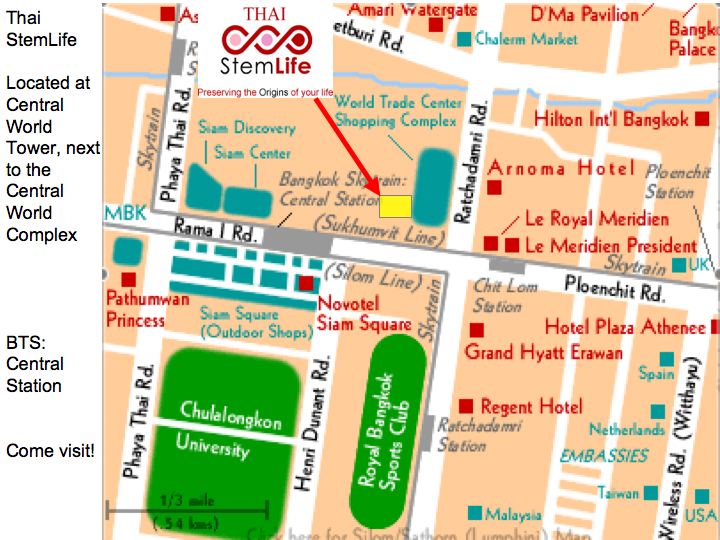
My colleague in Thai StemLife told me that he had written to the Bangkok Post regarding the article they published last month on the lack of an available cord blood bank in Thailand. I looked for it online but it appears that the article is no longer available on the Bangkok Post website, and can only be found on a cached folder on Google search . Just to make it easier to read the article, I decided to republish the letter in this entry because it also serves to educate on the differences in Stem Cells and also the information that makes it compelling for any expecting parent to make the obvious decision and bank cord blood stem cells locally.
If you are visiting Bangkok, please feel free to call and drop by our office in Central World Tower, downtown near the new Siam Paragon in Pathumwan. You should call in advance, just because the lifts are so secure, its almost impossible to find your way upstairs without a guide with a proper pass to our floor!
Letter published in Bangkok Post News, Saturday May 6th 2006:
STEM CELL STORAGE AVAILABLE LOCALLY
I read with interest your front-page article on stem cells published April 17, 2006. I feel compelled to respond to it as a number of inconsistencies is evident. The information provided is not correct and potentially misleading to residents of Thailand that are interested in storing their own and their babies' adult stem cells. Cord Blood stem cells can be stored in Thailand privately with THAI StemLife as well as with the private arm of the Thai Red Cross.
Substantial public confusion is maintained by the incomplete knowledge of the media trying to report on stem cells and mostly, what we hear are the two words: stem cells.
The reports make us feel like a Pandora's Box has been opened on questions of ethics and morals. Still, most of the time the only question that needs to be answered is whether someone with incomplete knowledge, background and after incomplete research should be allowed to write scientific articles.
Adult Stem Cells (ASC), include Bone Marrow Stem Cells (BMSC), Umbilical Cord Blood Stem Cells (UCBSC) and Peripheral Blood Stem Cells (PBSC). ASC have limited but still wide potency and plasticity to develop to most tissues of an organism. The ability of certain tissues in the adult (bone marrow, skin, liver and bone) to repair and renew indicates the presence of stem cells in all of us. Human bone marrow is already transplanted since many decades, with proven therapeutic effects, and lately other ASC sources are being used.
Umbilical cord blood is therefore an excellent alternative and never-ending source of stem cells. It is collected within five minutes from the umbilical cord and placenta after a baby is born, without any risk to the mother or baby. This blood that is normally discarded is rich in blood-forming cells. The cord blood is tested for viral, bacterial and fungal infections, frozen and stored at -196C at a cord blood bank for future use.
The transplant process is the same as for marrow and peripheral blood stem cell transplants. To date, more than 6,000 cord blood (UCBSC) transplants have been performed, among which it should be noted that the first worldwide cord blood transplant for thalassemia was performed in Thailand in 1995.
Moreover, ASC bone marrow transplants, PBSC heart and diabetic ulcer injections are taking place in Thailand. So local expertise is indeed abundant in the Kingdom, in contrast to what the article implies. Cryogenic storage has since July 2005 been available for Thai parents in the Kingdom with THAI StemLife, the first private cord blood bank, that provides this service 24 hours a day, seven days a week to all pregnant mothers at every hospital in Bangkok and throughout Thailand. Thai parents do not need to send their baby's precious blood out of the country, which would mean that risks for cold-chain disruptions and thus destruction of stem cells would be imminent and real.
Furthermore, if those precious stem cells are needed, the patient would not have to fly to Singapore but can be easily treated in local hospitals in Bangkok.
THAI StemLife is also involved in research of both peripheral blood and cord blood stem cells. Prices are also not as expensive as the article implies. THAI StemLife charges 40,000 baht as an initial fee including first year storage and has 9- and 18-year packages, bringing down the prices to 4,000 and 3,500 baht per year, respectively. The information that storage cost is 10,000 baht a week is absurd.
Moreover, the cost of cord blood stem cells (UCBSC) from abroad (mostly Taiwan) for a bone marrow transplant is close to 800,000 baht if found to match, thus significantly more expensive than life-long storage for own use with THAI StemLife.
Stem cells present a fantastic alternative difficult to overlook and the existence of local storage facilities in Thailand makes it easy for patients to decide for future storage, provided they are presented with unbiased and correct information.
DR KOSTAS I PAPADOPOULOS
Executive Board Director, THAI StemLife
www.thaistemlife.com
Tuesday, April 25, 2006
Cryo-Cell International Inc. changes from Vials to BAGS conforming to US AABB Cord Blood Stem Cell Banking Standards

I read recently that one of the oldest and largest banks in the US has recently announced their financial results and described at the same time that they had made a fundamental change in the way they bank cord blood stem cell units, resulting in a 5X increase in their price of cord blood banking.
The recent Cryo-Cell International Inc. (OTC Symbol: CCEL or CCCEC) First quarter results for 2006 showed that although revenues were up by 12% from 2005, cost of sales was up by 7% and marketing, general and administrative expenses were up by 5%, all compared to the first quarter 2005.
The increase in cost of sales was attributed to:
1) Increased cost in lab supplies
2) Sales Promotions and Cord Blood Collection Reimbursements
3) Service Enhancements
The 1st point involving lab supplies increase was due to "the Company's April 2005 implementation of a new processing methodology in accordance with newly established standards of the AABB (formerly known as American Association of Blood Banks). The new process utilizes closed-system bags in place of vial storage".
With regards to how they are going to maintain their on-going financial strength, Cryo-Cell International Inc has raised their prices of cord blood stem cell banking.
Cryo-Cell Price Change to reflect change in storage system:
Vials Storage- USD 315 (initial), USD 50 (on-going). ie. RM 1170 (initial) and RM 190 (yearly)
TO
BAG Storage - USD 1,595 (initial), USD 125 (on-going). ie. RM 6,061 (initial) and RM 475 (yearly)
This means that Cryo-Cell's cord blood stem cell banking program has increased by 5X and yearly by 2.5X.
What this price increase does show is that lab consumables when using a bag system is more expensive than vials. However, due to the new safety regulations on cord blood banking, cryo-bags are now the standard. It may be merely a matter of time before most stem cell banks using vials change to the bag system in order to conform to international standards.
Analysis and Reasoning:
Coming from the angle of usage, many proponents of vials argue that by storing in several vials, a patient may be able to use each vial for a single treatment. However, this is misleading especially since:
a) ex-vivo expansion is not readily available and expensive
b) not every bag of cord blood collected contains sufficient cells for splitting into multiple vials
c) thus far, transplanters have used whole bags of cord blood and now propose using double cords to constitute sufficient numbers.
However, from the angle of safety:
a) bags use closed system processing (cells not exposed to air during transfer stages)
b) In handling of the bag, cells won't be spilt (unlike vials, potential spillage if mishandled)
c) Labelling safety- the unit is kept as one
d) Better risk management for transplant (no popping of cap or transfer needed when it comes to an IV line)
I also read separately that Cryo-Cell made a licensing agreement with an Indian company called Lifecell. Lifecell pays licensing fees to Cryo-cell Intl. Inc. for its set up and operations- with licensing fees contributing approximately 10% of Cryo-cell's topline revenue. It is unclear to me from their website whether Lifecell in India uses bags or vials for cord blood stem cell banking and if they currently use vials, when or if they will also make the change to bag systems.
But, looking at the prices that Lifecell charges since its launch in November 2004:
Enrolment & Processing = 27,000 Rupees (USD 599 ; RM 2,183)
Yearly storage = 2,900 Rupees (USD 64 ; RM 234)
And taking into account that Lifecell started in late 2004, perhaps they may not be using the bag system.
I wonder if our competitor in Malaysia (check out their amusing blog here) will continue trying to promote the benefit of vials given the clear (yet expensive) message that Cryo-Cell sends by changing all of their processes and systems to accomodate the benefits of storage in bags. At StemLife we thought about these issues carefully from our inception, which is why we have always stored in cryo bags and only cryo bags, in spite of the temptation to choose relatively inexpensive vials.
BOTTOM LINE:
Cryo-Cell's announcement confirms the decision of StemLife, Malaysia's first stem cell bank and therapeutics company, to use bags for stem cell storage rather than vials. As Malaysia's first and only company* to have also used stem cells stored in bags, we have first hand knowledge in assisting doctors in the thawing and use of stem cells for therapies when the patients need them. All stem cell units released from our bank have successfully engrafted, a testament that StemLife's cryopreservation procedures are valid.
*StemLife has expanded now to Thailand where Thai StemLife also uses the bag system of stem cell storage. Additionally, we have clients banked from Indonesia and Singapore where they have chosen StemLife's stem cell banking program for their babies' cord blood stem cells.
Sunday, April 23, 2006
Misleading Bangkok Post article on Thailand Cord Blood Stem Cell Banking Availability

I read an article written up in the Bangkok post about Thai mothers "flocking" to bank their baby's cord blood stem cells at a foreign cord blood bank due to the service being unavailable in Thailand according to Thai Health Authorities. What the article failed to mention is that a local stem cell bank - Thai StemLife- has been operating and banking for expecting parents in Thailand since July 2005.
Additionally, the article quoted a doctor who mentioned that about 10-15% of mothers birthing at a reknown Bangkok Hospital were spending VAST amounts of money to do so (1st year 50,000 baht [USD 1,320], subsequent years 6,000 baht [USD 159]).
Thai StemLife is a joint venture between StemLife in Malaysia and reputable doctors and hospitals in Thailand. The entity, which is majority Thai owned, follows StemLife Malaysia's structure in laboratory operations and some co-marketing activities to leverage on cost saving functions. Thai StemLife has its own passionate and professional management who work hard to establish committment, credibility and great service to their clients. Clients are welcome to visit and tour Thai StemLife's facilities at the Central World Tower which boasts state of the art security for client's stem cells, full power back up and modern lab facilities rivalling those internationally.
Another mistake or perhaps misquote in the article states that the storage life of the cord blood cells is 20 years according to the CEO of the foreign bank. Actually, stem cells properly cryopreserved may be stored for longer than that, almost 20 years of data is already available- so there is no reason why stem cells can't last 30, 40 or even 50 years under the right conditions.
Thai parents, you can save a bit of money and see the tank your baby's stem cells are stored in just by dropping by Thai StemLife at Central World Tower (its even next to a convenient BTS stop!). Additionally, you could ask them who they've banked stem cells for and if your baby's stem cells are next to any famous babies... :)
Check out Thai StemLife's website here.
Or contact them directly:
THAI StemLife Headquarters
Address : 23rd. floor. The Offices at Central World.
999/9 Rama I rd. , Patumwan
, Bangkok 10330
Tel : +66(0)2 613 1515-8
Fax : +66(0)2 613 1519
Email : info@thaistemlife.co.th
24 Hr Hotline : +66(0)1 3407676
Subscribe to:
Comments (Atom)

 Posts
Posts

